
Table of Contents
Fuel economy is one of the first things buyers consider when choosing a practical sedan, especially for daily commuting. The Roewe i5 is often considered for its efficient 1.5L powertrain, comfortable cabin and practical size. But how does its fuel consumption change between city streets and highway driving?

Roewe i5 Fuel Consumption in City Driving
For many drivers, Roewe i5 fuel consumption city driving is more important than laboratory figures because daily commuting usually involves traffic lights, congestion, frequent acceleration and braking. Under these conditions, fuel consumption can be noticeably higher than on open roads.
Real-world reports show that city fuel economy varies considerably depending on traffic and driving style. Smooth acceleration, anticipating traffic lights and avoiding unnecessary hard braking can help reduce fuel use. Short trips, heavy traffic and frequent stop-and-go driving, on the other hand, can increase consumption.
Air conditioning is another factor worth considering. In hot weather, continuous air-conditioning use can add to fuel consumption, particularly when the vehicle spends a lot of time in slow-moving traffic.
Roewe i5 Real Fuel Consumption: What Should Drivers Expect?
The Roewe i5 real fuel consumption is not a single fixed number. Different drivers can achieve very different results with the same vehicle because of road conditions, driving habits, vehicle load, tire pressure and maintenance.
This is also why owner discussions are useful when researching fuel economy. Drivers commonly compare dashboard readings with fuel used between refueling stops, rather than relying only on the displayed average. For a more accurate long-term figure, recording fuel volume and distance over several tanks provides a better picture of actual consumption.
A well-maintained vehicle can also help keep fuel consumption stable. Correct tire pressure, timely oil and filter replacement, and avoiding unnecessary weight in the trunk are simple ways to support efficient driving.
Roewe i5 Highway Fuel Economy
Highway driving generally creates more favorable conditions for fuel efficiency. Once the vehicle reaches a steady cruising speed, there is less stop-and-go traffic and fewer repeated acceleration cycles. This allows the engine to operate more consistently than during urban commuting.
For buyers researching Roewe i5 highway fuel economy, steady-speed driving is therefore an important reference point. Highway consumption can be significantly lower than city consumption, although speed, road gradients, passenger load and air conditioning still make a difference.
Cruise control can also be useful on suitable roads because it helps maintain a consistent speed. However, drivers should always prioritize traffic conditions and safety rather than focusing solely on fuel economy.
City vs Highway: Which Is More Efficient?
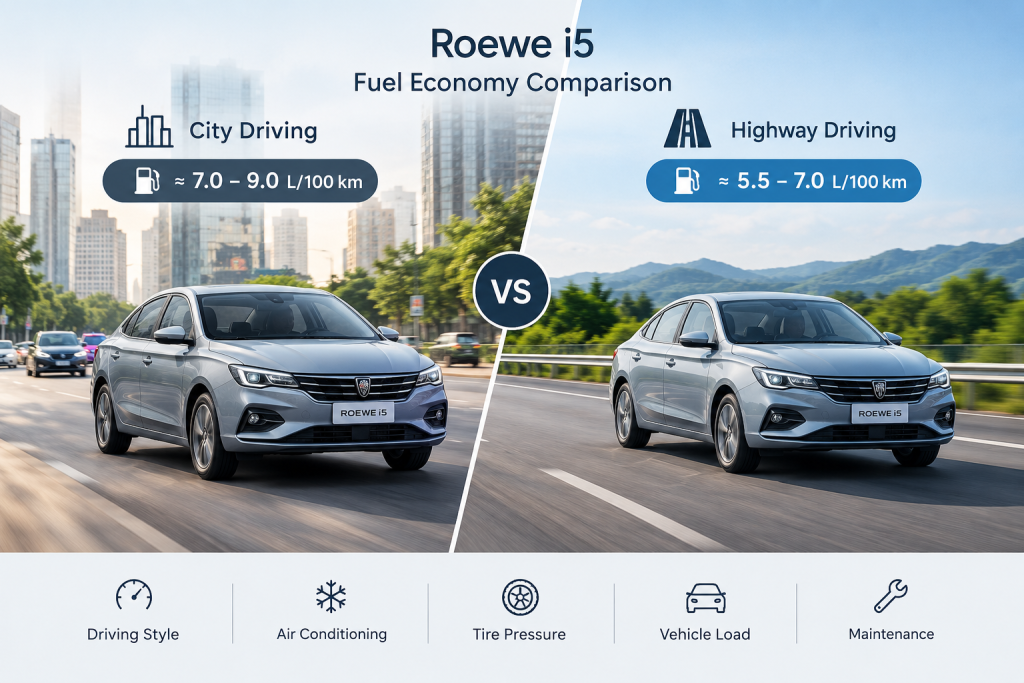
The answer is straightforward: highway driving is generally more fuel-efficient than congested urban driving. The difference becomes more noticeable when city traffic involves frequent stops, short journeys and heavy air-conditioning use.
| Comparison | City Driving | Highway Driving |
|---|---|---|
| Estimated Fuel Consumption | 7.0–9.0 L/100 km | 5.5–7.0 L/100 km |
| Traffic Conditions | Frequent stops and congestion | Steady-speed driving |
| Fuel Consumption | Generally higher | Generally lower |
| Main Influencing Factors | Traffic, short trips, air conditioning | Speed, road conditions, vehicle load |
| Driving Tips | Accelerate smoothly and avoid unnecessary idling | Maintain a steady, moderate speed |
*Note: The fuel consumption figures above are illustrative estimates for comparison, not verified official or guaranteed real-world figures. Actual consumption varies by model year, powertrain, driving habits and road conditions.
For daily commuters, the Roewe i5 sedan offers a practical balance between fuel economy and everyday usability. For buyers comparing vehicles, the most useful approach is to look at both official test figures and real-world driving conditions.
Ultimately, fuel economy depends not only on the car but also on how and where it is driven. Understanding these factors can help Roewe i5 buyers set more realistic expectations and get better efficiency from their vehicle.
FAQs
1. What is the real fuel consumption of the Roewe i5?
Real-world fuel consumption varies by model, transmission, traffic and driving style. Owner reports commonly show higher consumption in congested urban conditions and lower figures during steady highway driving.
2. Does traffic congestion increase Roewe i5 fuel consumption?
Yes. Frequent stopping, idling and repeated acceleration can noticeably increase fuel consumption. Heavy rush-hour traffic may produce significantly higher figures than open-road driving.
3. Does air conditioning affect Roewe i5 fuel economy?
Yes. Using air conditioning places additional load on the vehicle and can increase fuel consumption, particularly during hot weather and slow urban traffic.
4. Does driving style affect Roewe i5 fuel consumption?
Yes. Smooth acceleration, maintaining a consistent speed and avoiding unnecessary hard braking can help improve fuel efficiency. Aggressive acceleration and frequent braking generally use more fuel.
5. How can I reduce Roewe i5 fuel consumption in city traffic?
Avoid unnecessary idling, accelerate smoothly, anticipate traffic conditions and keep the vehicle properly maintained. Reducing unnecessary cargo weight can also help.
6. Is the fuel consumption shown on the Roewe i5 dashboard accurate?
The dashboard average provides a useful reference, but it may not exactly match fuel consumption calculated from actual refueling data. For a more reliable long-term figure, record the fuel added and distance driven over several tanks.
7. Does vehicle maintenance affect Roewe i5 fuel economy?
Yes. Tire condition, engine oil, air filters and the overall mechanical condition of the vehicle can influence fuel consumption. Regular maintenance helps keep the vehicle operating efficiently.